When Self-Doubt Gets Loud: A Nervous System Perspective
There are days when self-doubt doesn’t just whisper, it roars.
You know the ones. You sit down to write an email, speak up in a meeting, have a hard conversation, or take a step toward something that matters and suddenly the familiar chorus appears:
“Who do you think you are?”
“You’re going to mess this up.”
“Other people are more qualified than you.”
I know this place very well.
Years ago, I was preparing to teach a workshop. I’d been practicing as a psychologist for a long time. I knew the material. I cared deeply about the people who would be there.
And yet, the night before, I could feel my body tightening.
My stomach felt like a fist.
My chest was buzzing.
My thoughts started spiraling:
“What if you freeze?”
“What if they see you don’t know enough?”
“Who are you to be teaching this?”
From the outside, it looked like imposter syndrome. From the inside, it felt like an avalanche of shame and self-doubt.
In the past, I would have believed those thoughts. I would have taken them as evidence that something was wrong with me.
But over time, I began to understand something important.
My self-doubt was not a sign of weakness.
It was a sign that my nervous system did not feel safe.
My body was moving into a state of protection, old survival wiring waking up in response to the vulnerability of being seen.
Once I could recognize that, something softened. Instead of asking, “What’s wrong with me?” I started asking:
“What is my nervous system trying to protect me from right now?”
That shift, from self-attack to curiosity, changed everything.
Self-doubt as a nervous system state
From a nervous system perspective, self-doubt is often less about truth and more about safety.
When you’re about to:
try something new
be visible
set a boundary
say what you actually need
move toward a more authentic life
your system may register this as risky.
Old experiences of being judged, shamed, ignored, or rejected live in the body. The nervous system remembers, even when the mind says, “It’s fine, this is different.”
Self-doubt can show up like an internal brake pedal:
“If I convince you you’re not good enough, maybe you won’t take the risk. And if you don’t take the risk, maybe you won’t get hurt.”
Seen this way, self-doubt isn’t proof you’re inadequate. It’s your body trying, sometimes clumsily and painfully, to protect your tender places.
You are not the harsh voice in your head.
You are the one who is hearing it.
A simple practice for when self-doubt floods you
You can use this when self-doubt gets loud. It’s meant to help you come back into your body with a bit more kindness.
1) Pause and name what’s happening
Quietly say to yourself:
“I’m noticing self-doubt.”
Or:
“A protective part of me is really loud right now.”
We’re not arguing with it or believing it. We’re naming it as a state, not a truth.
2) Feel your contact with the ground
If you’re sitting, let your feet rest on the floor. Notice the points of contact: heels, toes, soles. If you can, gently press your feet down a little and feel the support rising back up to meet you.
This reminds your nervous system: There is ground under me. I’m supported right now.
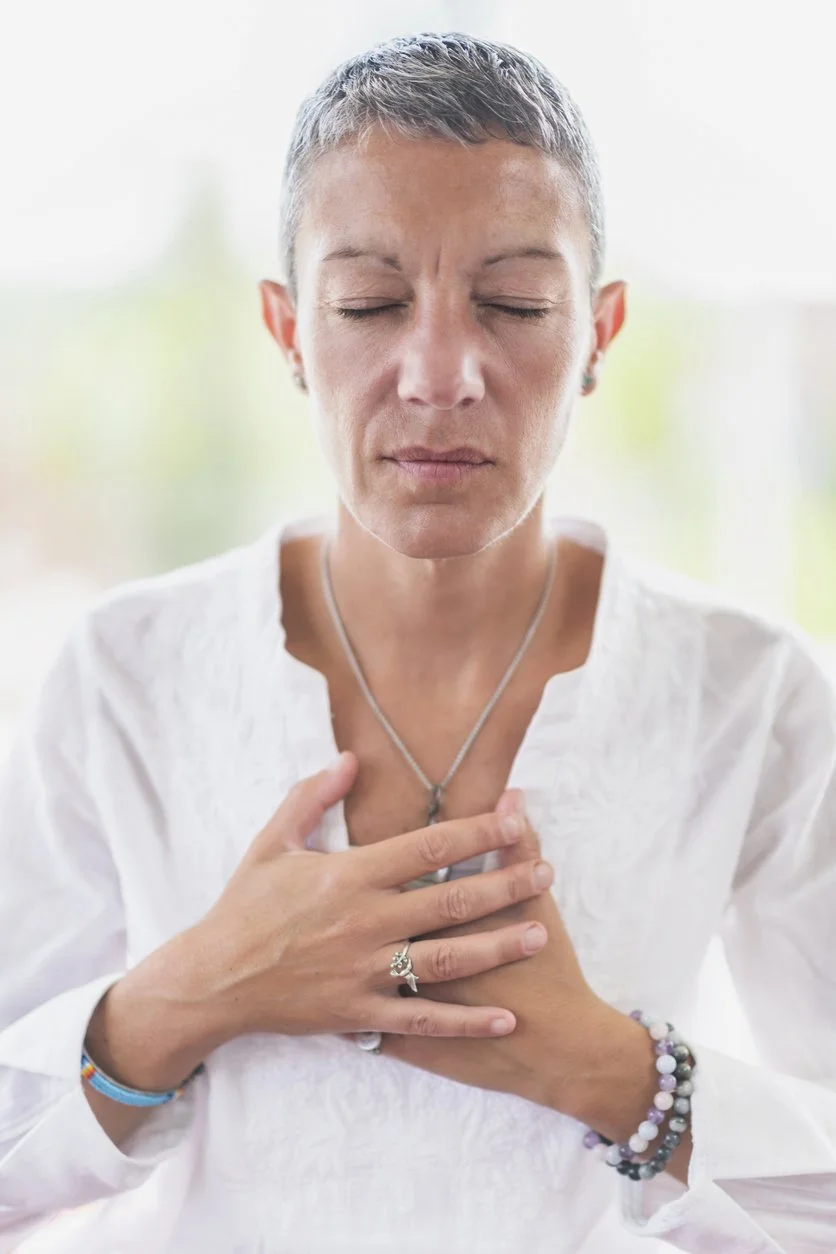
3) Place a hand or two on your body
Let one hand rest on your chest or your upper abdomen. Feel the warmth and gentle weight of your own hand.
You might say softly:
“I’m here.”
“I’m with you.”
As if you were speaking to a younger part of yourself.
4) Lengthen your exhale
Take a comfortable breath in through your nose. Then exhale slowly, just a bit longer than your inhale.
For example:
inhale to a slow count of 4, exhale to a count of 6.
Do this 5 to 7 times, without strain.
A longer exhale helps signal to your nervous system that you are not in immediate danger.
5) Offer a kinder sentence
When you feel even 10 percent more settled, try offering yourself a gentle phrase, not as a slogan, but as a possibility:
“It’s okay to feel scared and still take a small step.”
“I don’t have to be perfect to be worthy.”
“This is my nervous system trying to protect me.”
Let the words land in your body. If they don’t fit, you can change them. The point is not to positive-think your way out of this, but to let your body feel a slightly kinder tone.
Self-doubt may still visit you. It certainly still visits me.
But over time, when we meet it as a nervous system state rather than a verdict on our worth, it begins to loosen. The sharp edges soften. We get a little more room to breathe, to choose, to take the next right step.
You don’t have to eradicate self-doubt to live a meaningful life. You just need enough regulation, enough kindness, to move with it differently.